A bare plot, and the shade it did not have.
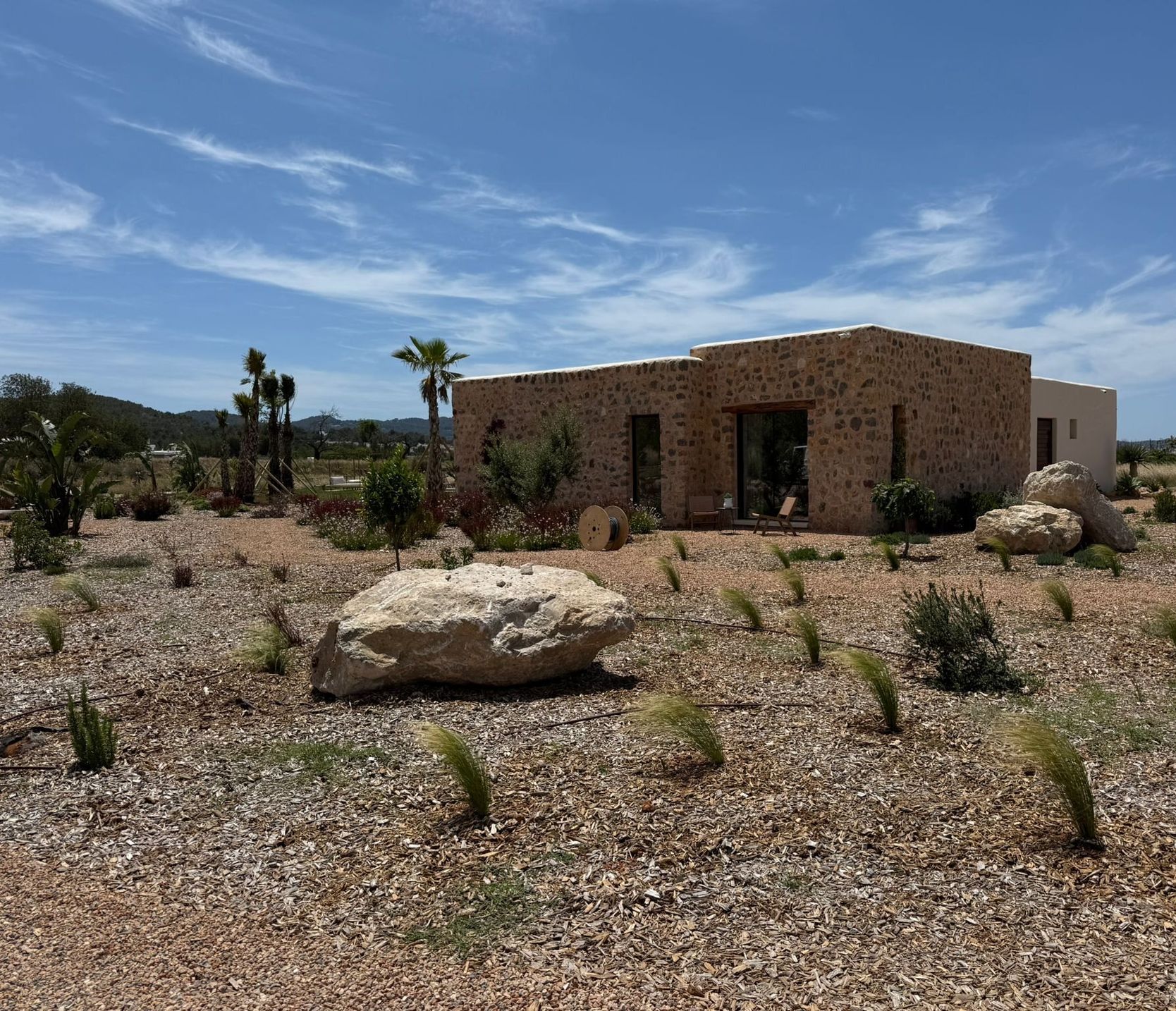
Site & brief
The house was new and the plot was bare. Not neglected, not overgrown — flat, open, and scraped to the edges, the way a building site is left. There was nowhere on it you would willingly stand between June and September.
That is the problem this garden was built to solve. Shade is the one thing on a plot like this that cannot be bought later and dropped into place cheaply. Everything else — beds, lawn, irrigation, mulch — can be added a year on. A tall tree takes either a decade of growth or a crane.
It was a new build in Sant Antoni de Portmany, and it was landscaped before the house went to market.
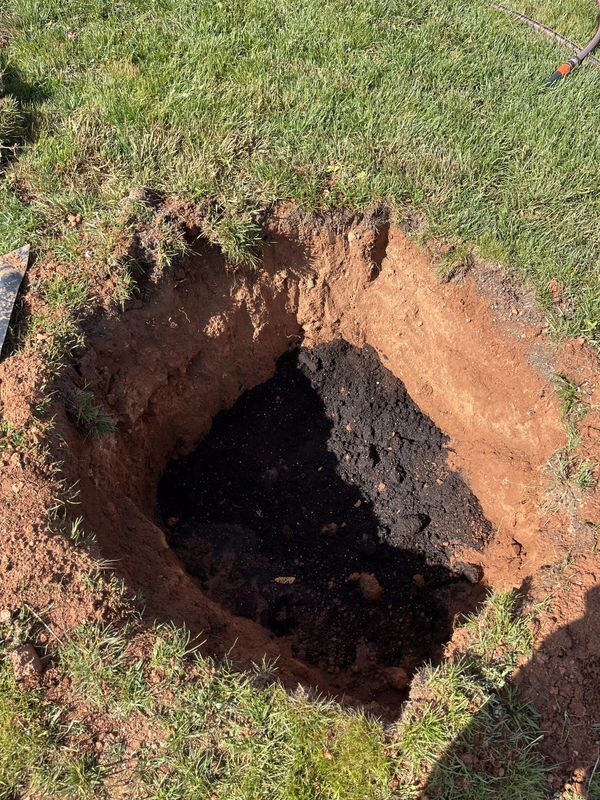
A new-build plot does not have soil in the sense a gardener means it. The topsoil goes early, machines run over what is left all winter, and what remains is compacted subsoil with builder's rubble through it. Plant into that as it is and the roots meet a wall.
So we dug out every planting position properly and backfilled it with compost brought in by the load. The photograph of a single pit cut into the lawn — red subsoil at the sides, dark compost filling the middle — is the whole method in one frame. It is the difference between a plant that establishes in its first year and one that sits still for three.
Approach
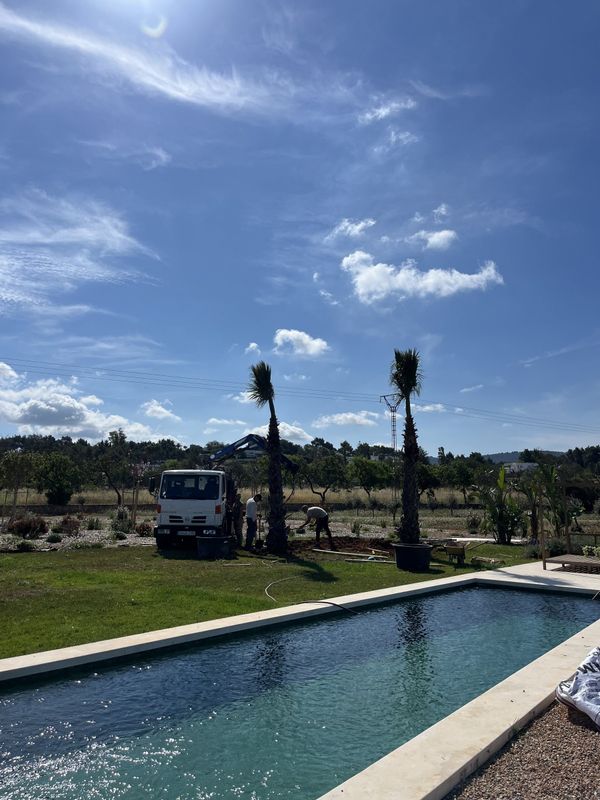
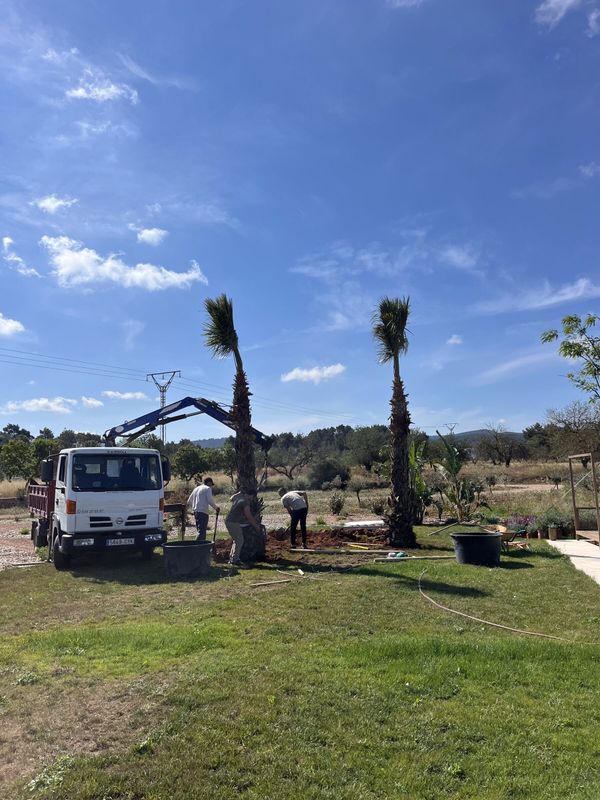
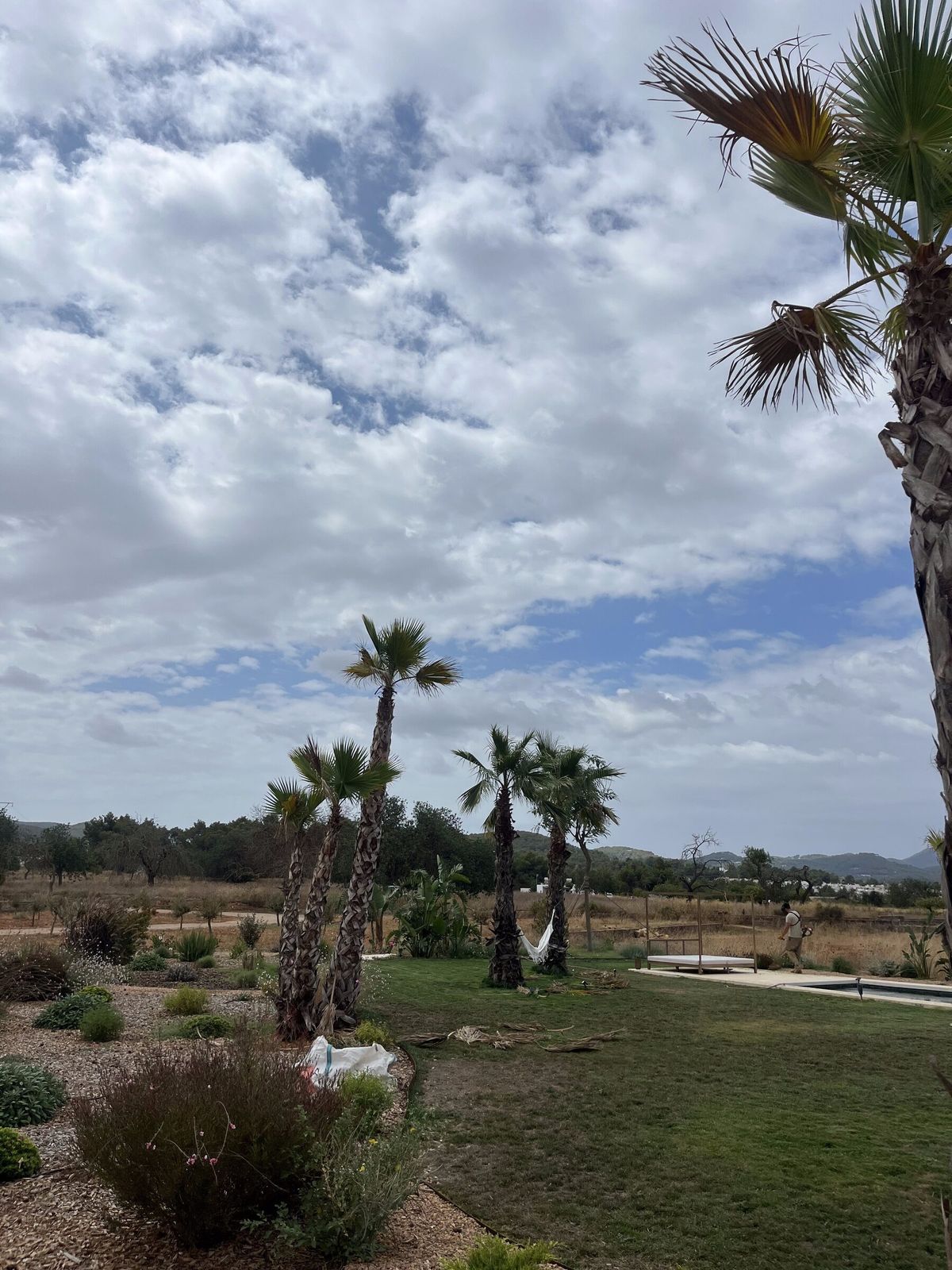
Eight Washingtonia palms went in, seven of them over six metres, and one multi-headed specimen carrying three trunks from a single base. They arrived on a truck with a crane, because at that size there is no other way to move them: a palm of that height has a root ball far smaller than the crown it has to hold up.
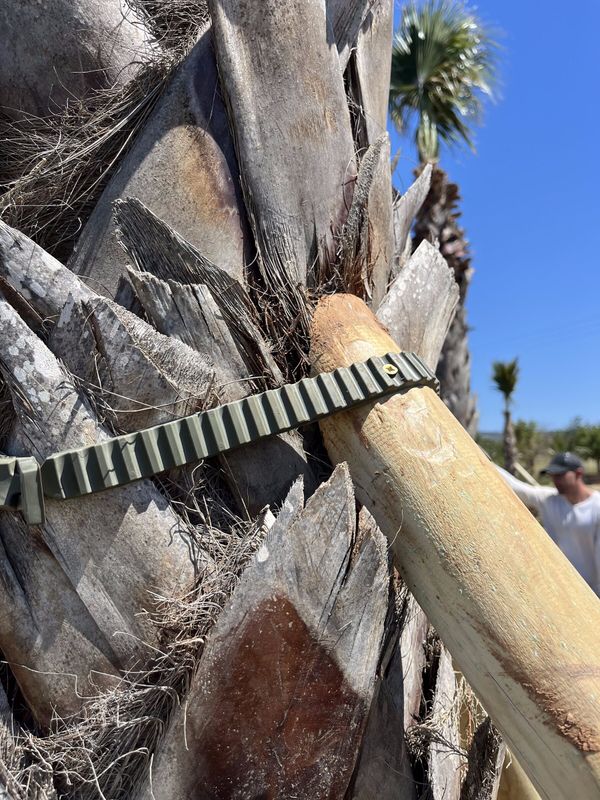
Which is why the timber braces matter more than they look. A newly planted palm has no anchorage of its own yet; it is standing in a hole, not rooted in the ground. The braces hold it upright and, more importantly, hold it still, so the new roots forming at the base are not being torn every time the wind gets up. They come off once the palm is holding itself.
What came out, and how it's watered
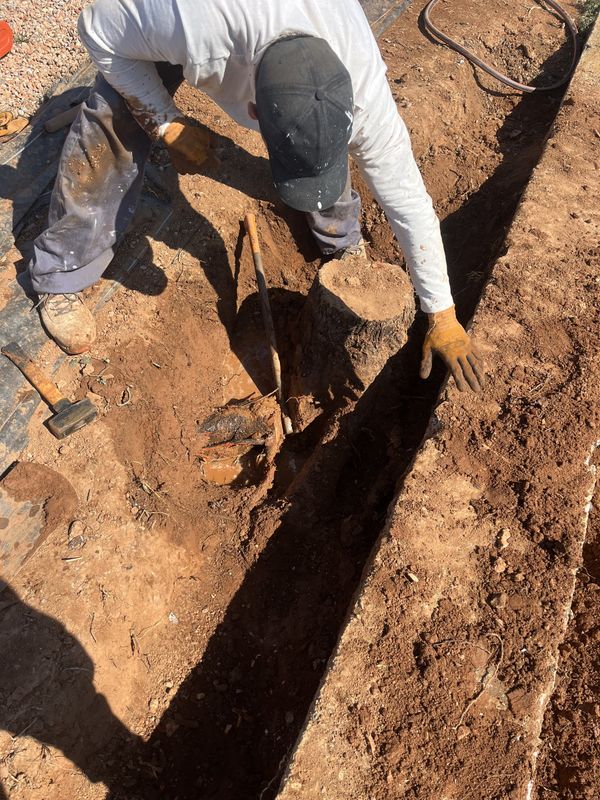
One thing came out that had been there before us: an almond stump beside the retaining wall, cut down long before the house was built. It went because the wall needed more concrete behind it, not because it was in the way of a design.
We do not remove trees here for convenience. Where one has to go, there is a structural reason and we say so.
In its place we built a green climbing wall by the pool — beams set into the ground and jasmine planted to run up them. Screening, scent, and shade close to where people actually sit.
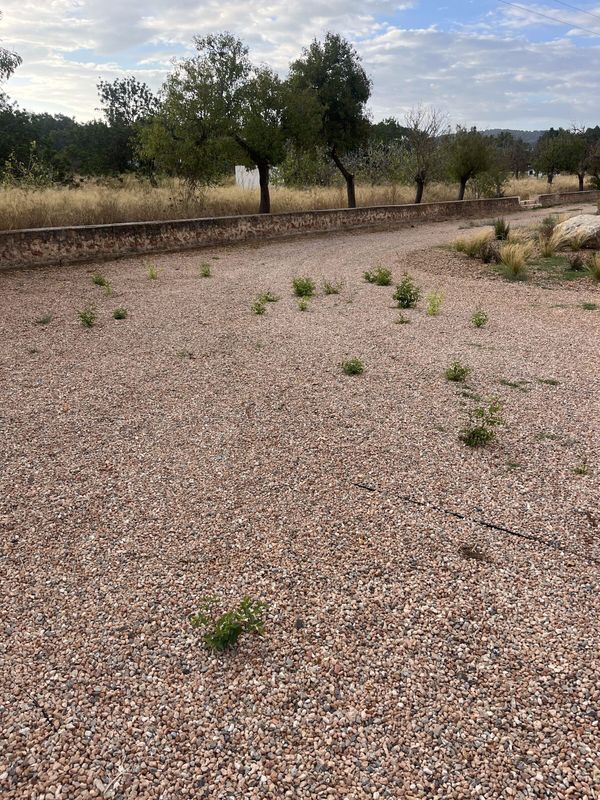
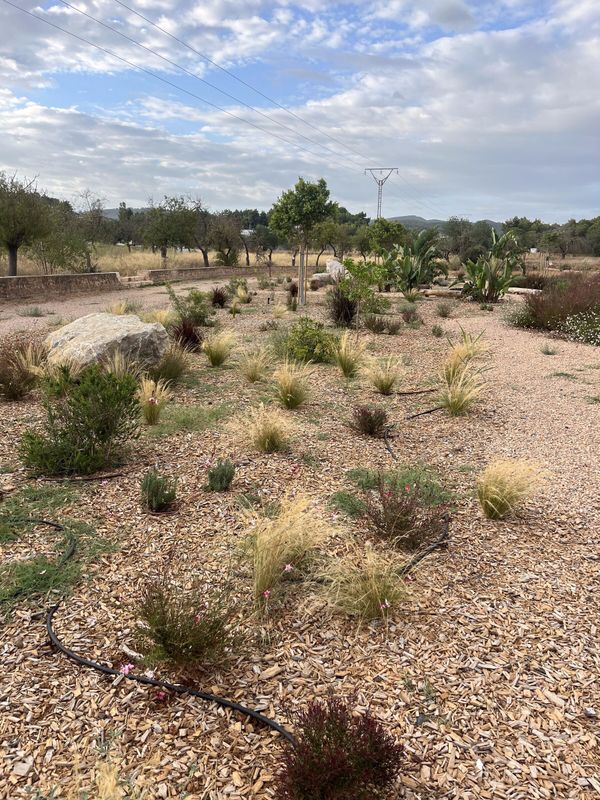
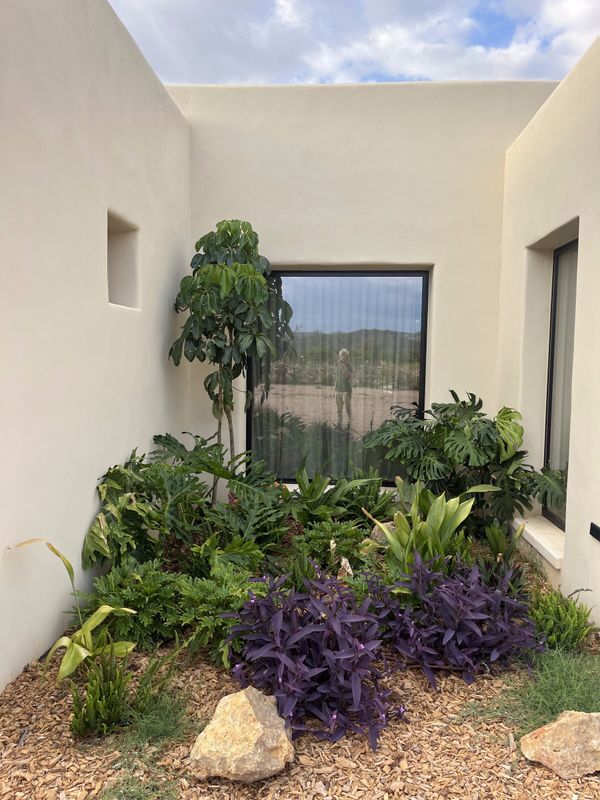
Elsewhere on the plot the planting reads differently by design. Under a shaded window, purple heart and ferns hold a cool, damp-looking bed that never actually needs much water. Out on the open gravel, Mexican feather grass grows among boulders, replacing what had been bare stone and the weeds it grew instead.
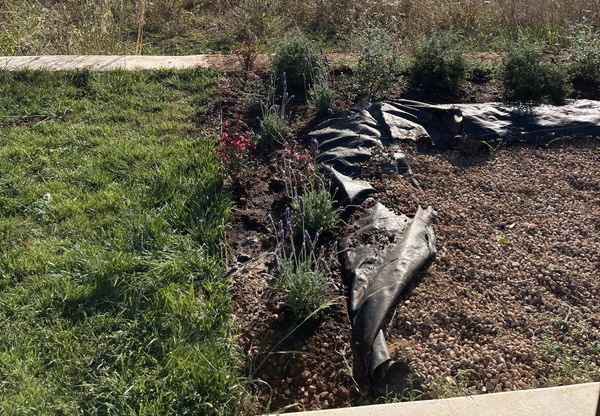
There was black weed membrane in the beds. It came out.
Membrane looks like a solution for about two years. Then the mulch on top of it breaks down into exactly the sort of fine material weeds germinate in, so they grow on the sheet instead of under it, and the sheet stops the leaf litter and compost above it from ever reaching the soil below. Meanwhile the roots of everything you actually planted grow into the fabric and through it, so removing it later means cutting.
There are places for it — under a gravel parking area, where nothing is meant to grow at all. In a planted bed it costs more to remove than it saves.
We upgraded the irrigation and programmed it by zone as part of the works rather than adding it afterwards, which is the only sensible time to do it: the trenches were already open for everything else.
Mulch is the other half of the same job. Gravel over the dry beds, wood chip around the newer planting — both there so that water put into the ground in the evening is still in the ground the next afternoon, instead of leaving through the surface by ten in the morning.
- Washingtonia palm (Washingtonia) — Eight in all, planted directly from the truck once each hole was excavated and ready. Seven over six metres, plus one multi-headed specimen with three trunks from a single base. Craned in and braced until rooted.
- Jasmine — Planted to climb the beam wall by the pool.
- Lavender — In the mulched beds along the lawn edge.
- Purple heart (Tradescantia pallida) — With ferns, in the shaded bed under a window.
- Mexican feather grass (Nassella tenuissima) — With boulders and wood-chip mulch, replacing bare gravel and weeds.
What it looks like now
The plot has shade it did not have. The lawn between the palms came in, and the part of the garden nobody could use in August is now where the hammock goes.