Most summers, somewhere on the island, a stretch of pine forest or dry scrub catches fire. It rarely makes headlines beyond Ibiza, and it’s usually out within a few hours — but every year it’s the same reminder for anyone with land near woodland: in July and August, the vegetation around a house is fuel.
If you own a villa or finca near pine forest or dry scrubland — the wooded interior, or the edge where houses meet forest around Santa Eulària, Sant Josep or Sant Joan — clearing that perimeter is the single most effective thing you can do before the dry season locks in.
Why the risk keeps climbing
Ibiza’s exposure isn’t hypothetical. Long, dry summers with almost no rain from June to September. Strong winds that carry embers well past a fire’s original edge. Pine woodland on rustic plots that hasn’t been thinned in years. A growing number of houses built right up against that woodland, sometimes with no clearance at all around the perimeter.
Clearance, brushcutting, firebreak maintenance — not the same job
These terms get used interchangeably. They’re not the same work.
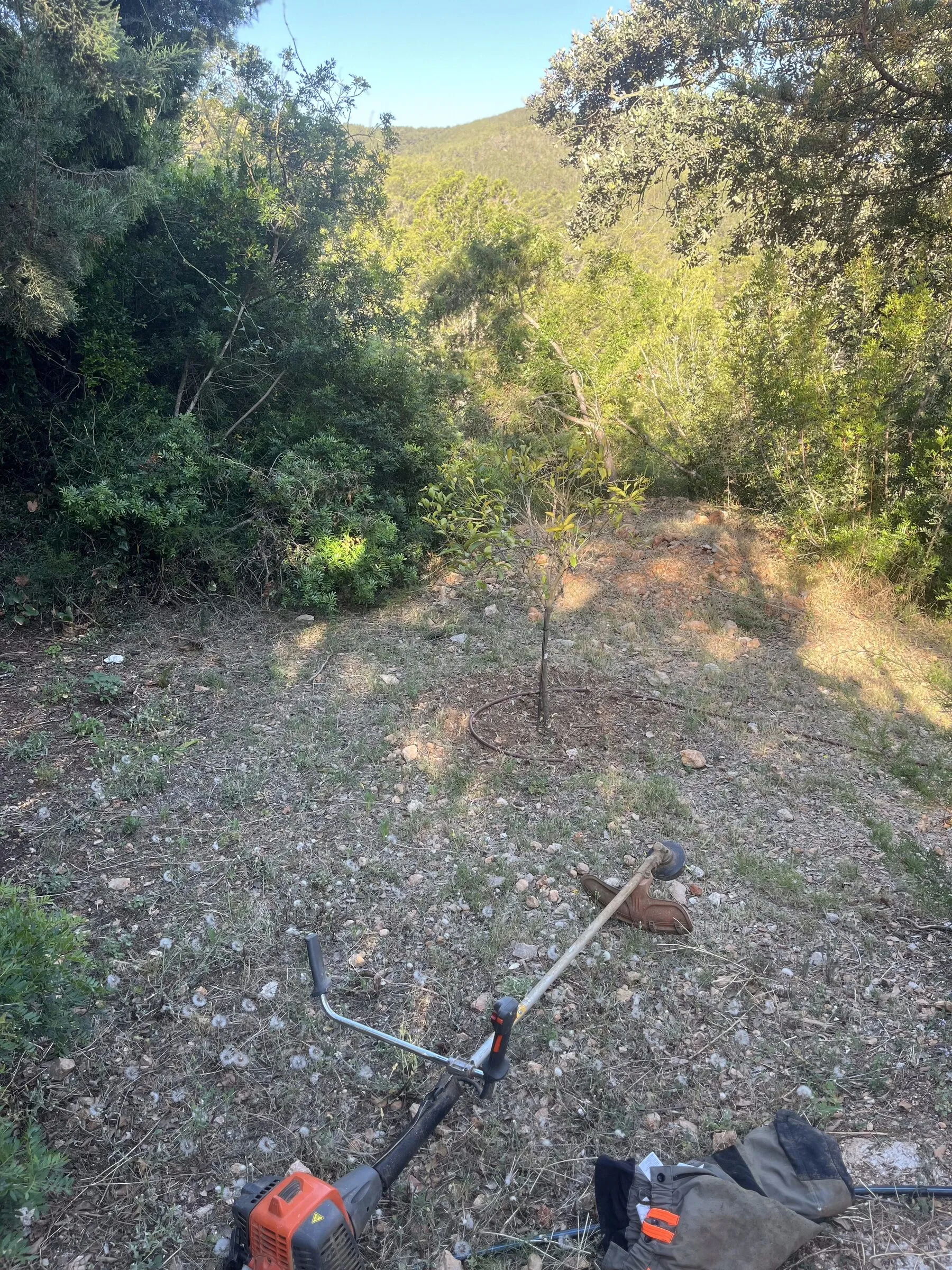
Forest clearance is the heavier first pass — removing dense undergrowth, dead wood, invasive scrub and overgrown brush from land that hasn’t been touched in years.
Brushcutting is the routine, recurring visit — cutting back grass and regrowth so a cleared area doesn’t quietly revert to fuel load. This is what keeps a firebreak working, year after year, not the first clearance on its own.
Firebreak maintenance combines both, applied specifically to the perimeter around a structure or its access road.
Most properties need them at different points: an initial heavier clearance, then scheduled brushcutting visits — typically a few times a year, depending on rainfall and how fast things grow back.
Selective, not scorched earth
The native vegetation on a property — savina (Juniperus phoenicea), wild olive, rosemary, native pine — is worth keeping. Indiscriminate clearing does more harm than good: it invites erosion, opens the ground to invasive species, and strips out the structure native plants give the soil.
Done properly, clearance is selective. Thin, space, prune, remove what’s genuinely fuel load — and leave the rest, so the land stays alive.
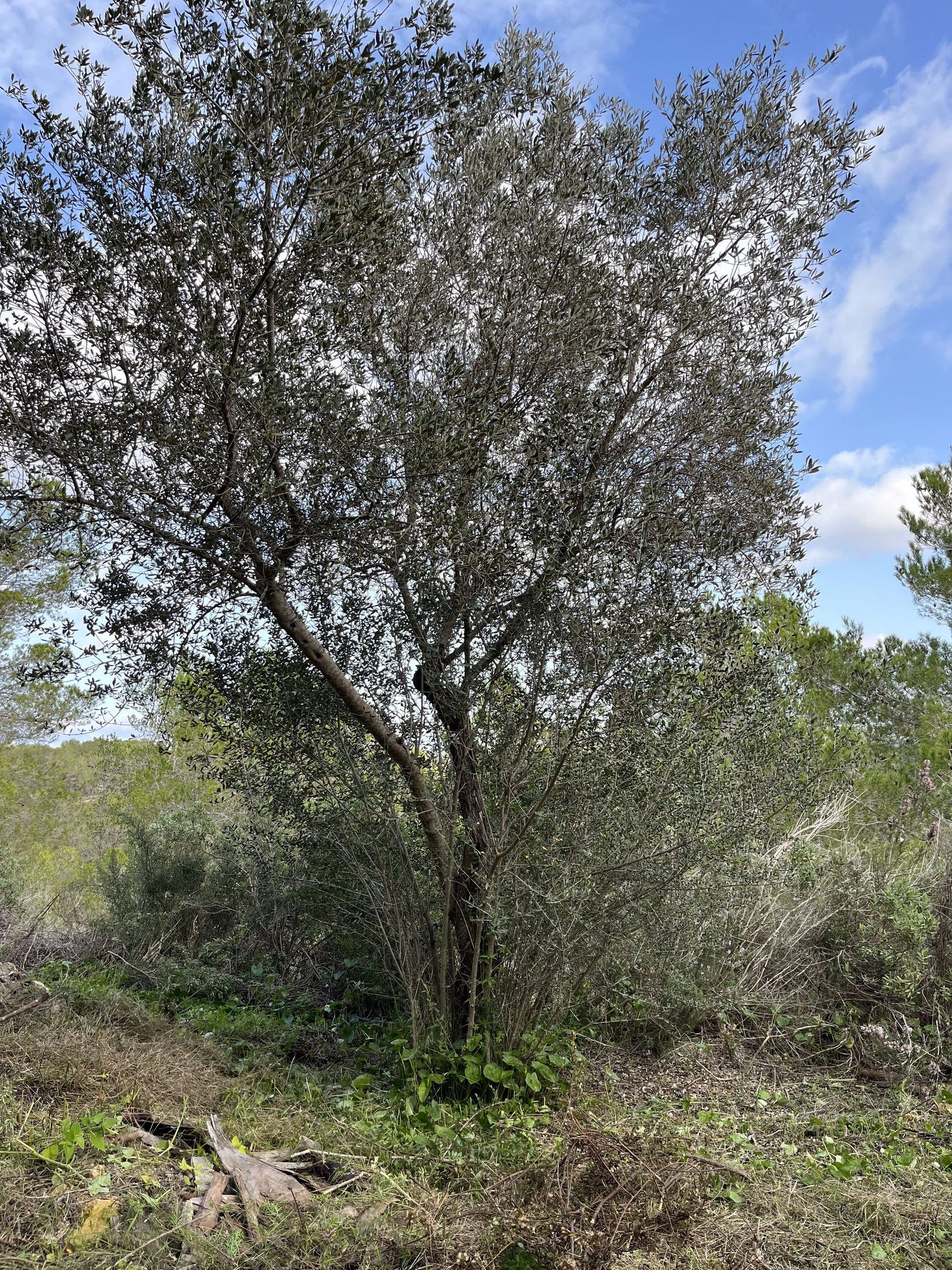
The olive above is what that looks like in practice. It was not in the plan, because nobody knew it was there. It came out of the clearance — brush cut back from what looked like more brush, and an old olive still alive underneath it.
Ground here that has been left alone for twenty years still holds trees that were planted deliberately once and have been overgrown since: olives, carobs, almonds, the odd fig. Clearing it with a machine takes all of that out in an afternoon, and a tree that took forty years to grow cannot be put back.
We pruned this one the following winter — hard, but to a frame it could recover from — and cleaned and planted the ground underneath.
When to schedule it
The best time to clear is before the dry season locks in — roughly February to May, once winter growth has flushed but before temperatures and wind pick up. Leave it until July and you’re working under time pressure, competing with every other property owner on the island for the same crews.
If the spring window is already gone this year, a late clearance is still far better than none. Worth having the property assessed now rather than mid-summer.
Questions we’re asked
Will clearing remove everything around the house? No. The aim is to break up fuel continuity, not eliminate every plant. We space and prune trees and reduce shrub cover — a well-done firebreak still looks like a garden.
How often does a firebreak need maintenance? Most properties need brushcutting a few times a year, depending on rainfall, vegetation type and how fast growth returns.
What does it cost? Every site is different — a first clearance on overgrown land is a different job from a routine brushcutting visit on a maintained perimeter. We quote after a site visit, not before.
Get your perimeter assessed before summer peaks
If you own a villa or finca near woodland, get the perimeter looked at in winter, not in August. Clearance and fire prevention is one of the services we run every season — get in touch for a site visit.
Species in this post
- Aleppo pine (Pinus halepensis)
- Savina (Juniperus phoenicea)
- Wild olive (Olea europaea var. sylvestris)
- Rosemary (Rosmarinus officinalis)